
Flood-Damaged Trees in Cleveland, TX: After the East Fork Rises
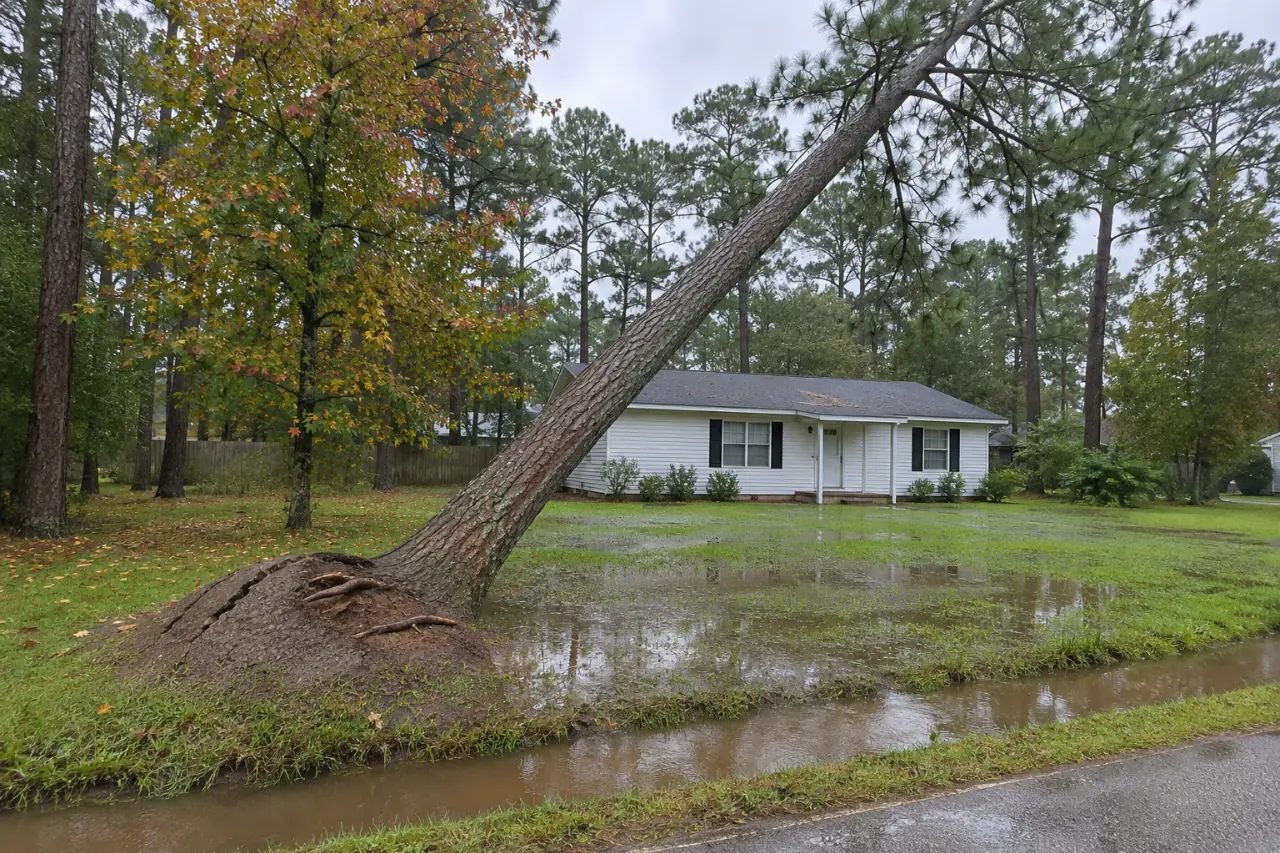
After a flood in Cleveland, Texas, deal first with trees that have started to lean or lift their roots: the Texas A&M Forest Service says that a mature tree leaning more than 30 degrees, or uprooted with more than three inches of its roots exposed, should be assessed by an arborist for possible removal, and that you should not try to stand it back up or stake it (checked Nov 18, 2026).
Cleveland has seen this at full scale. During Harvey in 2017, the National Weather Service recorded "MAJOR/RECORD LEVELS" on the East Fork of the San Jacinto River, "CAUSING SIGNIFICANT FLOODING IN CLEVELAND, WILLIAMS AND PLUM GROVE" (checked Nov 18, 2026).
Where the water rises around Cleveland
The city's own history page describes Cleveland as "surrounded by the East Fork, and San Jacinto Rivers" (City of Cleveland, City History, checked Nov 18, 2026). The weather service's Harvey page for the Houston/Galveston area (NWS Houston/Galveston, Hurricane Harvey, checked Nov 18, 2026) records, for the storm-total period of August 25 to 31, 2017:
- 36.42 inches of rain at a gauge 3.6 miles south of Cleveland, and 30.65 inches at one 5.0 miles south.
- 49.31 inches at a gauge just east of Dayton.
- Major and record levels on the East Fork of the San Jacinto River, flooding Cleveland, Williams and Plum Grove, and major flooding on the East Fork in Montgomery County.
- "LIBERTY...MAJOR/RECORD FLOODING OCCURRED ALONG THE TRINITY RIVER."
FEMA's Harvey declaration, DR-4332, lists Liberty, Montgomery and San Jacinto counties for both individual and public assistance (FEMA, checked Nov 18, 2026).
Smaller floods come more often. During Beryl in July 2024, the weather service noted "flash flooding near the town of Cleveland with water and debris reported over County Road 1010" (NWS Houston/Galveston, checked Nov 18, 2026).
Why trees tip when the flatwoods are soaked
Texas Parks and Wildlife describes the soils of this region's pine-hardwood flatwoods as fine-textured, over "a somewhat impermeable subsurface horizon, which leads to a perched water table," on ground that is "very gently undulating to flat" (TPWD, checked Nov 18, 2026). The Natural Resources Conservation Service describes the wetter loamy uplands of the region as having a seasonally high water table (NRCS ecological site description, checked Nov 18, 2026).
When rain sits on a slow-draining layer, the top of the soil turns to mud, and a big tree's root plate is sitting in that mud. Add wind on a crown full of wet leaves or needles, and the whole plate can roll. That is how a tree can come up with a wide disk of roots and soil and leave a matching hole, instead of snapping at the base.
What the Forest Service says to do when the water goes down
From the Texas A&M Forest Service's flooding guidance (Texas A&M Forest Service, Trees & Flooding, checked Nov 18, 2026):
- "Look up! Stay away from trees that are within 10 feet of or touching power lines."
- "Watch for downed trees across roads, homes, and bridges."
- "Look for root plate shifting." A mature tree leaning more than 30 degrees or uprooted with more than three inches of roots exposed should be assessed by an arborist for possible removal; don't stand it up or stake it.
- "Document tree damage and loss by periodically photographing your trees."
- "Treat standing trees for bark loss within 5–7 days of damage." Floating debris scrapes bark off trunks.
- "Remove deposited soil that has accumulated under the tree canopy to prevent further damage to root systems."
- "Minimize soil disturbance."
The photographs matter for more than insurance. Dated pictures taken every few weeks show whether a tree is thinning, leaning further or losing bark, which is hard to judge from memory.
Trees on the East Fork and creek banks
If your property runs down to the East Fork, a creek or a big drainage ditch, the rules change. The Forest Service says "Do not move fallen trees along riverbanks as they help stabilize banks and slow water flow," and "Do not fell trees or push woody debris into streams or rivers" (checked Nov 18, 2026). A tree that falls into the water from your bank can still be a problem when it threatens a bridge, culvert or building, so describe exactly where it lies when you call.
Silt, fill and Liberty County's flood rules
After a flood, it is tempting to bring in dirt to raise a low spot or rebuild a washed-out bank. Outside city limits, Liberty County's flood damage prevention ordinance applies "to all areas of special flood hazard within the jurisdiction of Liberty County." It defines development to include "filling, grading, paving, excavation," requires a development permit through the county's floodplain administrator, and prohibits fill and other encroachment in the regulatory floodway unless engineering shows no rise in flood levels (Liberty County ordinance, accepted Oct 13, 2020, checked Nov 18, 2026). The county's Engineering Department, at 624 Fannin Street in Liberty, takes those questions at 936-402-0246. Inside Cleveland, the city's non-structure development permit application lists fill and grading and asks whether the work is in a floodplain or floodway (City of Cleveland, checked Nov 18, 2026), so ask Community Development first.
Removing fallen trees isn't listed as development in that ordinance. Hauling in fill around the trees you keep is, and piling soil over roots is also what the Forest Service warns against.
Oaks that decline after high water
Water oaks, willow oaks and other hardwoods that stood in floodwater are stressed trees, and stressed oaks are where hypoxylon canker shows up. A Texas A&M AgriLife fact sheet says the disease appears "when they are stressed by environmental extremes," shows as bark falling off to expose a crust that ends up dark and burnt-looking, and that by then "the tree becomes hazardous" and "should be carefully inspected and considered for removal" (Texas A&M Plant Disease Diagnostic Lab, 2009, checked Nov 18, 2026).
Flood questions
- Will flood insurance pay for my trees?
- Ask your agent what your flood policy and your homeowner's policy each cover for trees and debris. The answer is in the policy itself.
- The tree looks fine. Should I take it down anyway?
- Not on that basis alone. Watch it, photograph it, clear silt off its roots, and call if it starts to lean, thin out or lose bark.
- Can a crew work while the yard is still wet?
- Trucks sink and rut soaked lawns. A dangerous tree can be handled with climbing and hand work; others can wait for the ground to firm up.