
Pine Beetles in Cleveland, TX: Ips, Southern Pine Beetle and Red Needles
When a pine or two dies around Cleveland, Texas, Ips engraver beetles are the likelier cause; southern pine beetles "have not been a significant problem in Texas for several decades," though the Texas A&M Forest Service reports that "In 2026, southern pine beetles were detected in a monitoring trap," with no infested trees reported (page updated Nov 17, 2026, checked Nov 18, 2026). Either way, once a pine's needles turn red, the Forest Service says "the tree is dead and cannot be saved."
A dead pine near a house is a removal job, and the sooner it comes down the less brittle it is.
How to tell which beetle is in the tree
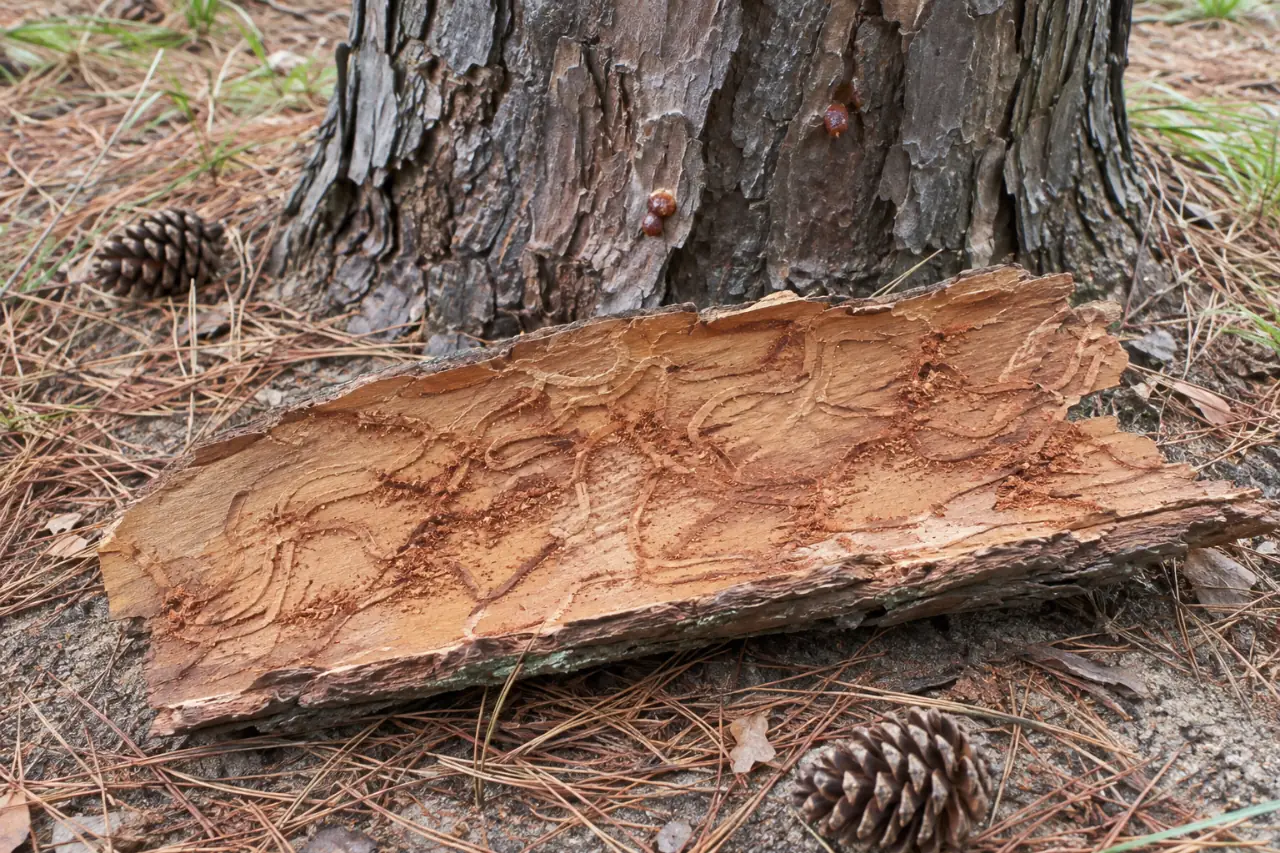
The Forest Service's guide to pine bark beetles (Texas A&M Forest Service, checked Nov 18, 2026) separates the two by where they bore in, the color of the resin blobs ("pitch tubes") they leave on the bark, and the tunnels under the bark:
| Sign | Ips engraver beetles | Southern pine beetle |
|---|---|---|
| Where they enter | "on the flat bark plates" | "in the crevices between the bark plates" |
| Pitch tubes | "reddish-brown" as frass mixes with resin | "generally a creamy white color" |
| Tunnels under the bark | Y, H or I shaped | Winding S shapes |
| How many trees | "usually only a few trees are involved in each infestation" | "can exponentially spread to nearby otherwise healthy pines" |
The same page names a third: "Another pine bark beetle of concern in east Texas is the black turpentine beetle." It also describes a small southern pine engraver that is "almost always confined to branches in the tops of trees."
Red needles: how fast, and what they mean
An attacked pine's foliage goes from green to yellow to red. In late-summer heat and drought, the Forest Service says that change can happen "in around three weeks." In summers when daily highs sit in the 90s, one beetle generation, egg to adult, "may be as short as 21 days." By the time you notice the color from the street, the beetles that killed the tree may already have left it.
That timing matters for neighbors too. If you see several pines turning red in a cluster, or the red spreads from one tree to the next over a few weeks, describe it when you call. Southern pine beetle spots grow outward; Ips usually take a few trees and stop.
What brings beetles into healthy-looking pines
- Drought. "When prolonged drought occurs in East Texas, especially during the growing season, pine beetle activity is likely to increase," the Forest Service says.
- Root damage and packed soil. "Root damage caused by construction and drought are the two most common stress factors for the pine trees in your lawn," the Forest Service says, and it advises avoiding root damage and reducing soil compaction to help prevent engraver attacks. Trenching for a new water line, parking trucks under pines, or bulldozing up to the trunks while a neighboring lot is cleared all do that.
- Storm damage. A pine that lost its top, cracked, or had its roots shifted by wind and wet ground is a stressed tree.
Around Cleveland that combination is common. Liberty County is growing fast: the Census Bureau estimates 121,364 people lived there on July 1, 2025, up 32.4% from its 2020 base (U.S. Census Bureau QuickFacts, checked Nov 18, 2026). Lots being cleared and built on next to standing pines mean roots cut, soil packed and drainage changed.
Should a beetle-killed pine come down?
The Forest Service treats the two beetles differently:
- Ips: "Direct control is rarely needed" in a forest setting. If control is needed, "cutting and removing the infested trees from the property is the best course of action." Removing trees the beetles have already left is "not necessary unless the dead tree poses a safety risk."
- Southern pine beetle: felling infested trees and leaving them lying in place is "counterproductive." The Forest Service suggests getting the opinion of a forestry professional before deciding how to handle an active spot.
Around a house, the "safety risk" line is the one that usually decides it. A dead pine standing within reach of a roof, a driveway, a fence or a road will drop limbs and eventually its top, and dead wood gets more brittle every month, which makes it harder and riskier to climb and rig. A dead pine in the back of a 5-acre tract with nothing under it is a different call.
When an infested pine comes down near other pines, ask what happens to the wood. Logs and slash with beetles still in them, left stacked against healthy trees, are not what the Forest Service has in mind.
Keeping the pines you have
- Water "slowly and deeply" during long droughts, as the Forest Service recommends, especially pines near new construction.
- Keep vehicles, trailers and piles of dirt or brush off the root zone.
- Don't wound pines in the heat of summer if it can wait. Trimming dead limbs is fine; skinning bark with a mower or truck isn't.
- Have storm-cracked and broken-topped pines looked at instead of waiting to see what happens.
If it isn't beetles
Pines also shed older needles every fall, which can look alarming when the inner crown goes brown all at once while the branch tips stay green. A pine that is red out to the tip of every branch is a different story. The tunnel patterns the Forest Service describes are under the bark, so peeling back a piece of loose bark tells the contractor a lot.
Pine beetle questions
- Can a beetle-attacked pine be sprayed and saved?
- Once the needles are red, no. The Forest Service is clear that the tree is dead at that point.
- Is southern pine beetle back around Cleveland?
- The Forest Service reported a 2026 detection in a monitoring trap and no reported infested trees, without naming where. It says it is monitoring for a return.
- Will a dead pine fall soon?
- There's no set timeline. Dead pines lose limbs first and can snap in the next strong wind. What it would hit matters more than how long it has been dead.
- What does removing a dead pine cost?
- Angi lists pine removal at $250 to $1,500 (checked Nov 18, 2026). See the cost page and tree removal.