
Tree Removal in Cleveland, TX: Tall Pines and Water Oaks Beside the House
Tree removal in Cleveland, Texas most often means taking down a tall loblolly pine or a water oak that stands within reach of a roof, and close to a house that job is done from the top down, piece by piece, rather than by dropping the whole tree. You generally don't need a city permit to do it: the City of Cleveland's code sets no tree-removal permit for private property, and its published list of jobs that require a permit does not include cutting a tree (checked Nov 18, 2026), and Texas law generally keeps a city from blocking removal of a dead, diseased or dangerous tree.
What usually decides the price and the method here is height, lean, what the tree would land on, and whether the ground is firm enough for a truck.
Which trees come down most around Cleveland?
Texas Parks and Wildlife's description of the pine-hardwood flatwoods that cover this part of East Texas reads like a list of local yard trees. On the slightly higher ground: loblolly pine, shortleaf pine and slash pine, with oaks mixed in. In the wetter low spots: water oak, willow oak, laurel oak, blackgum, sweetgum and green ash, over a shrub layer of yaupon, wax myrtle and possumhaw. The same source notes that Chinese tallow "may invade this system" (TPWD, checked Nov 18, 2026).
The removals people ask about most fall into a few groups:
- Pines that have turned red or brown. The Texas A&M Forest Service is blunt: "Once the needles turn red, the tree is dead and cannot be saved" (Texas A&M Forest Service, checked Nov 18, 2026). The pine beetle page covers how that happens.
- Oaks shedding bark in plates. A Texas A&M AgriLife fact sheet on hypoxylon canker describes outer bark falling away to expose a crust that ends up "dark brown to black," and says that by then "the structural integrity of the wood is compromised and the tree becomes hazardous" (Texas A&M Plant Disease Diagnostic Lab, 2009, checked Nov 18, 2026).
- Trees left leaning by a storm or a flood. Soaked soil lets a whole root plate shift. The flood page explains the 30-degree line the Forest Service draws.
- Trees that simply got too big for the spot. A pine planted near a slab decades ago, a sweetgum over the driveway, a tallow volunteer against the fence.
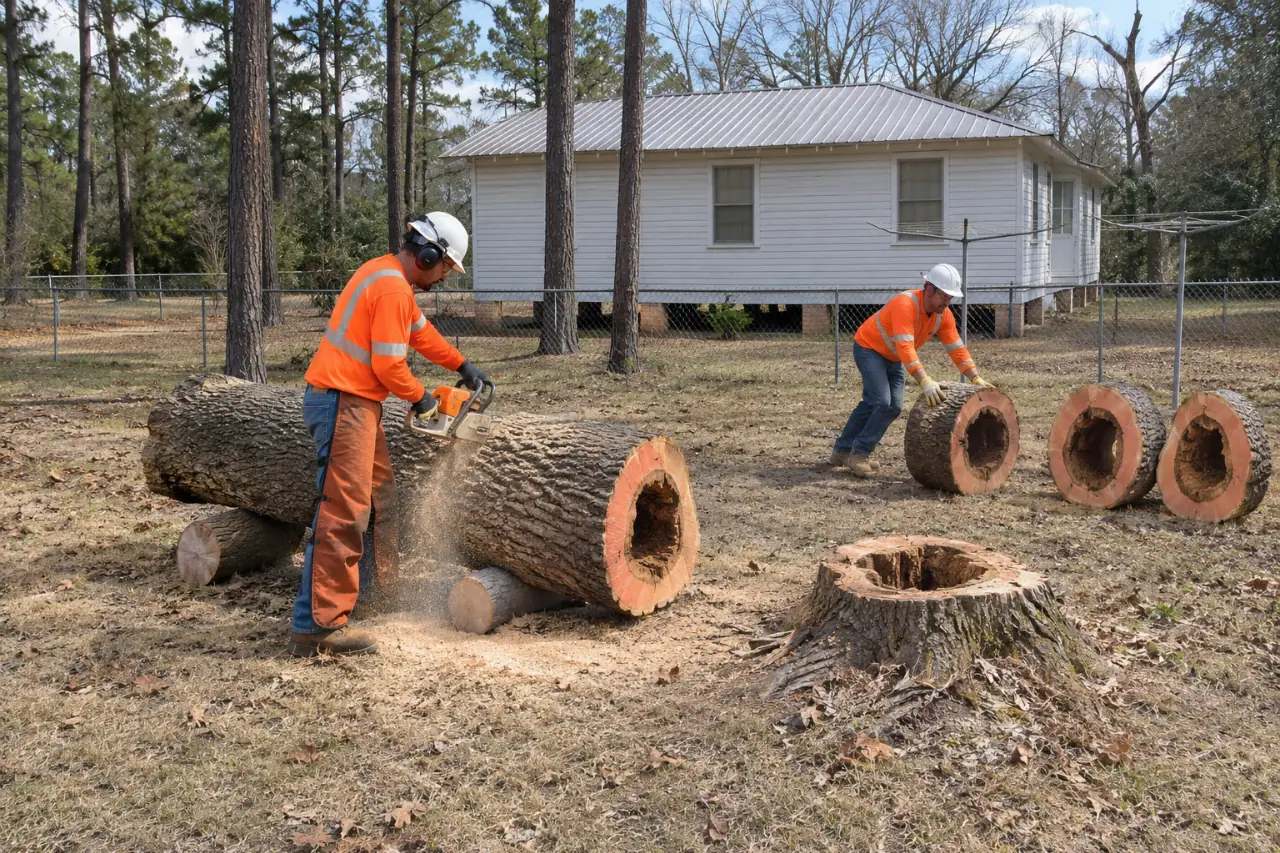
How a tall pine comes down next to a house
When a tree has open ground on one side at least as long as the tree is tall, a crew may fell it in one piece toward that open side. Around most Cleveland houses there is a roof, a fence, a shop, a neighbor's yard or a road in the way, so the tree is taken apart instead:
- Look first. The crew checks the lean, any dead tops or hanging limbs, cracks in the trunk, the soil at the base, and wires. A pine with a dead top can drop pieces while someone is working below it.
- Get up the tree. A climber on ropes, or a bucket truck if one can reach the tree without sinking in soft ground.
- Limb it from the top down. Limbs are cut and either dropped into a clear landing zone or tied off and lowered on a rope run through a pulley high in the tree.
- Take the trunk in sections. Pine trunks are tall and straight, so they usually come down in log-length pieces, each lowered or dropped where it can't bounce into anything.
- Fell what's left. Once the remaining stem is short enough to land in open space, it is cut at the base.
- Clean up. Brush goes through a chipper, logs are hauled or cut into rounds, and the area is raked. Whether the stump is ground is a separate line on most prices.
A crane is the other option when a tree leans over a roof and can't safely be climbed. Angi puts crane service at about $500 extra, or about $250 to $600 a day (Angi, checked Nov 18, 2026). The contractor decides which method fits after seeing the tree.
Why wet ground changes the job here
The flatwoods soils around Cleveland sit over a layer that water passes through slowly, which TPWD says "leads to a perched water table" (checked Nov 18, 2026). In practice that means yards stay soft for days after heavy rain. A bucket truck or a loaded log trailer that drives fine in a dry spell can rut a lawn badly or get stuck after a wet week. Expect a contractor to ask about the ground, to suggest waiting for it to firm up when the tree isn't an emergency, or to plan more climbing and hand-carrying instead of driving in.
Wet ground matters for the tree too. The Texas A&M Forest Service warns against compacting soil and damaging roots around pines, because stressed pines draw bark beetles (checked Nov 18, 2026). If you're taking one tree out of a group, ask how equipment will get in without grinding over the roots of the trees you're keeping.
Do you need permission to remove a tree in Cleveland, Texas?
For a tree in your own yard, no. The city's code of ordinances has no tree-removal permit for private property (City of Cleveland Code of Ordinances, checked Nov 18, 2026). The city's "When Is A Permit Required" list names permits for building work, fences, roofs, driveways, pools and demolition, but not tree removal, and it says questions about a specific project go to Development Services (City of Cleveland, checked Nov 18, 2026).
Texas law sets a floor under any city rule. Under subsection (h) of Texas Local Government Code §212.905, no Texas city may forbid taking out, or attach a tree mitigation fee to, any tree which "is diseased or dead" or which "poses an imminent or immediate threat to persons or property" (Tex. Local Gov't Code §212.905, checked Nov 18, 2026). So even where a Texas city does regulate trees, it generally can't stop you from removing a dead or dangerous one.
Two practical notes. If a falling tree flattens your fence, rebuilding that fence is on the city's permit list. And if the job grows into grading or filling a low spot in a mapped flood hazard area outside the city, Liberty County's flood ordinance counts that as development. The tree rules page has both.
Where does the wood go?
With the contractor, in most cases. The City of Cleveland's brush policy says hired contractors, family and friends who remove trees "are responsible for the disposal of all materials trimmed or cut" (City of Cleveland, checked Nov 18, 2026). Frontier Waste's monthly bulk and brush pickup lists "tree debris- from a contractor" among the things it won't take, and the city's natural waste drop-off on Highway 321 says "NO CONTRACTORS PERMITTED" (checked Nov 18, 2026).
So when you hear a price, ask what leaves the property: trunk wood, brush, chips, the stump grindings. Some people keep pine rounds or ask for oak cut to firewood length; others want everything gone. Each choice changes the price.
When a removal shouldn't wait
- A tree or big limb is resting on the service line that feeds your house. Call the electric company first and keep away; see the power line page.
- The soil on one side of the trunk has heaved up or cracked open, or roots have lifted, after rain or wind.
- A pine near the house has gone red from the top down, or has small pitch tubes all over its bark.
- A storm left a split trunk, a hung-up limb or a top that snapped and is hanging in the crown.
Removal questions from Cleveland homeowners
- What does removing one tree cost?
- Lawn Love's national figures run $285 to $435 for a tree up to 30 feet and $870 to $1,160 for one 60 to 80 feet tall (updated Oct 5, 2026, checked Nov 18, 2026). The cost page has more ranges and what pushes them.
- Can I take down a dead pine myself?
- Nothing in the city's permit list stops you, but dead pines get brittle and drop tops and limbs without warning. If it's tall and near anything you care about, that's the kind of tree a crew with ropes is set up for.
- My neighbor's tree is leaning over my house. Can I remove it?
- Start by talking with your neighbor, since the tree stands on their land. If it falls on your house in a storm, the Texas Department of Insurance says the neighbor's policy probably won't pay unless the neighbor was at fault, and you can file on your own (checked Nov 18, 2026).
- Will the crew grind the stump the same day?
- Often, if a grinder is on the truck, but stump grinding is usually priced separately. See stump grinding.